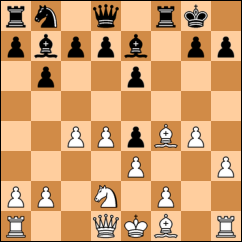
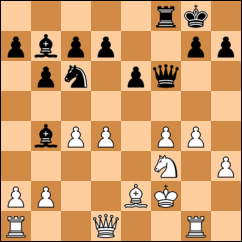
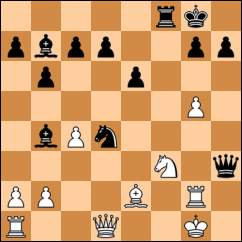
Thursday, 3 December 2015

Game 12 - club match. Swale vs Snodland

Swale vs Snodland - Board One
Thursday 3 December 2015
White: D Fowler (143) - Black: K. Nevols

A rematch of my third game of the season. This time I have the Black pieces.

1. e4 d5
2. exd5 Qxd5
3. Nc3 Qa5

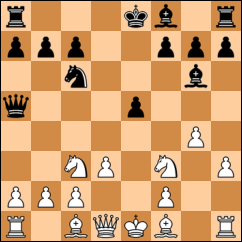
The Centre Counter / Scandinavian Defence is wheeled out once more. White chooses an unusual plan to fianchetto the king's bishop.

4. g3 Nf6
5. Bg2 c6
6. d4 Bg4

To force a weakening of the kingside. If now 7. Nf3 then 7. ... Qh5.

7. f3 Bf5
8. Nge2 e6
9. O-O Nbd7
10. Bf4 Be7

All standard stuff for Black so far. The location of White's bishop on g2 is unusual - it is often found on c4 by now.
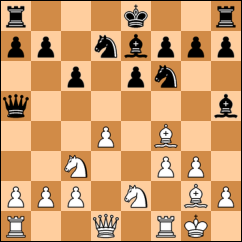


11. Ne4

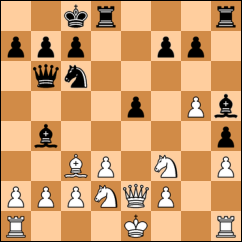
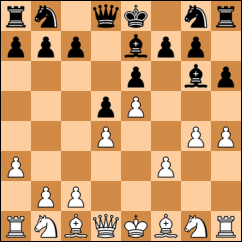
I now had a long twenty minute think, which left me with 43 minutes to get to move 35. After the last game, I did not want to get my king stuck in the middle again. But equally allowing White to take control of the d6 square had its perils too. And Nxe4 just strengthens the white centre. Eventually I think I found the best move which defends d6 by way of an indirect attack on e3.

(Incidentally the computer recommends 11. .. O-O 12. Nd6 Bg6 and meeting 13. Nxb7 with 13. .. Qb4! or 12. Bd6 Rfe8 13. Bxe7 Rxe7 14. Nd6 Bg6 15. Nxb7 Qb4! The possibility of moving the queen to b4 I did not see - I just did not like the idea of a white piece on d6 in principle).

11. ... Nd5
12. Qd2 Qxd2
13. Bxd2 O-O

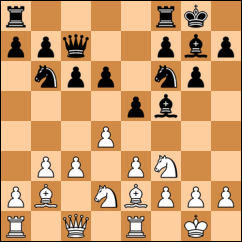
White decides to exchange off the queens. I was not too displeased at this point as I considered how to get my rooks into the game.

14. Nf4 Rac8

White has 34 minutes left for 21 moves and Black has 37. We were both putting in the minutes.

15. c3

This surprised me. I had expected c4 but now that the bishop can no longer go to a5 I have a good square for my knight.

15. ...  N7b6
16. b3 Rfd8
17. Rad1 Nxf4
18. Bxf4 Nd5
19. Bd2 Rd7

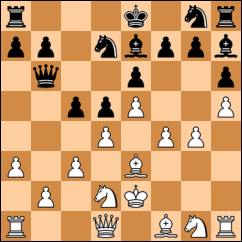
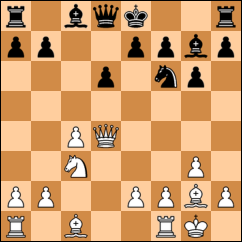
Satisfied so far. I am planning to exploit the awkward position of White's black-squared bishop by doubling the rooks and breaking with c5. White finds a good plan which now throws me off balance.
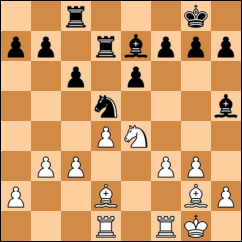


20. g4 Bg6
21. f4! Rcd8

White has 26 minutes left for 14 moves while I have 14 minutes.

Better would be 21. ... Bxe4 22. Bxe4 Nf6. 23. Bf3. The f4-5 push I had overlooked and now underestimated. However I still felt comfortable and now make a huge miscalculation.

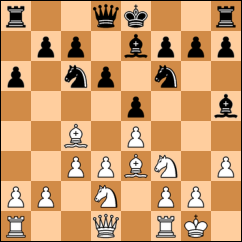
22. Ng3 Bh4?

22. .. h6 better. After preparing a c5 break, the bishop goes off on completely the wrong diagonal.

(The computer suggests an evacuation of the white-squared bishop with 22. .. Bc2 23. Rc1 Bd3 24. Rf3 Ba6 and then countering f5 with e5).

23. f5 Bxg3
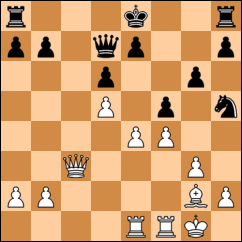
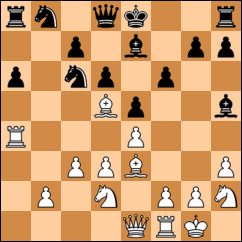
24. fxg6 Bxh2+??

Better 24. ... Bc7 25. gxf7+ Rxf7 26. Rxf7 Kxf7 27. Rf1+ where White is better but not yet winning. However, here I am having an attack of 'chess blindness' as I think I am winning a pawn.

25. Kxh2 hxg6

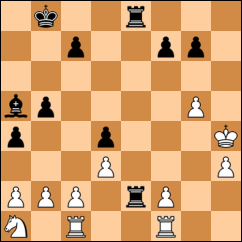
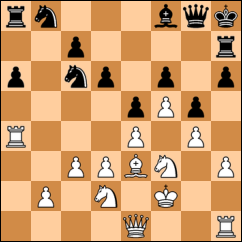
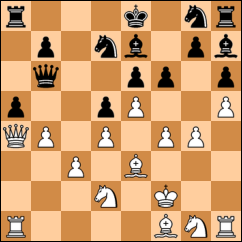
Now I counted the pawns as I thought I had won one, and with satisfaction saw I had won two - only to my horror to see I was a piece down! For the next few minutes I stared at the scoresheet trying to work out how I had miscalculated. Where did that piece go? Not only that but he had two bishops to my knight and the h-file was asking to be invaded.

This was a four board match and we were 2-1 up. I only needed a draw for us to take the match and began kicking myself for being too clever again. I wondered how difficult it would be to take up Bridge.
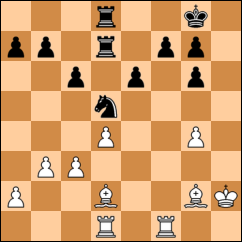


26. Bxd5 cxd5?!

The poker players have an expression for it - being 'on tilt'- that when you've made a mistake you are so fed up, your concentration goes and you continue making mistakes. Taking back with the rook here would have left an e5 break possible. Blocking the file where one has doubled rooks does not make sense.

27. Rf3 Rc8
28. g5 Rc6
29. Kg2

White is now playing well and has used this moves to gain space and close areas of the position in preparation for the h-file invasion. I decided my only chance to get a draw would be to try to lure his pawns forward on the queenside to try to get some sort of breakthrough in the confusion. But playing 29. .. b5 would have been better to place the rooks behind the pawns.

29. ...  Ra6
30. a4 Rb6
31. b4 Ra6
32. Ra1 b5
33. a5 Rc6

Well, that didn't achieve much. My only chance to breakthrough would have to be on the c-file through maybe an exchange sacrifice. I expected White to wander the king over to defend c3, move the bishop to f4, and then invade the h-file. I could not see how I could combat this plan.

34. Rh1 Kf8
35. Rh8+ Ke7
36. Rg8


Now we were past the time control, which I had made with two minutes spare, and had a long think. The g-pawn was going to go. The f-pawn could be under attack. The rooks could invade along the h-file and then the eighth rank. I had to get the king over to the queenside and defend as best as I could. So the following move is based on the principle that I might need a white square for the king. On balance, 36. ... a6 is probably better.

36. ... Rc4
37. Rxg7 Ke8
38. Rg8+ Ke7
39. Rh3 Rd8

Now I expected Rg7 with king over to c2 and bishop to f4-e5-f6.

40. Rxd8 Kxd8

But I was relieved to see a pair of rooks come off.

41. Rh8+ Ke7
42. Rb8

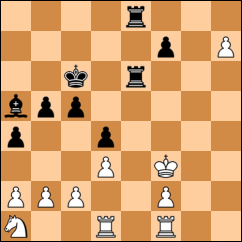
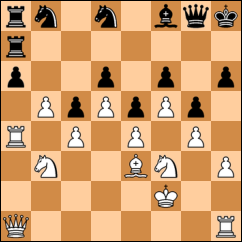
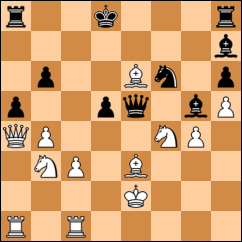
Time for another think. Should I resign? If 42. .. a6 then 43. Rb6 Rc8 44. Rxa6 Rb8 45. Bf4 Rc8 46. Rb6 Rxc3 47. Rxb5 - White is a clear piece up with two passed pawns.

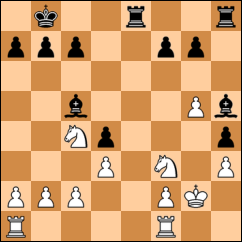
My only chance of a swindle was to get my rook into the forward half of the board and see if I could get perpetual check or at least pick up a pawn or two. Then suddenly I saw that if I could get my rook to the c2 square I would get my piece back! I would have to sacrifice a couple of pawns but it was worth a go.
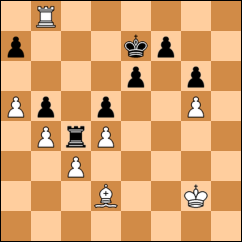


42. ...  e5!

Why not?

43. dxe5 d4
44. cxd4 Rc2

Made it. I will get my piece back but be two pawns down.

45. Rxb5?

Make that one pawn. 45. Kf3 Rxd2 46. Ke3 would hold on to the two pawn lead.

45. ...  Rxd2+
46. Kf3 Rxd4

Now I perked up as I have some real chances of holding the draw.

47. Rb7+ Ke6
48. Rxa7 Rxb4
49. a6 Ra4
50. Ra8 Kxe5
51. a7 Kf5

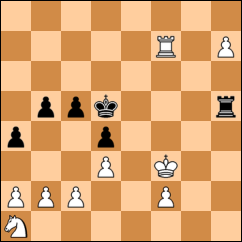
Nicely shielded by the f-pawn. Material is now equal and I breathed a sigh of relief as I might have got out of jail.
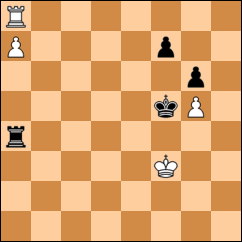


52. Rb8 Ra3+
53. Ke2 Rxa7

Pushing his king away seemed like a good idea at the time. I was concerned about a mating net.

54. Rb5+ Kf4
55. Kd3

Wait a minute! Now I was thinking - I could win this!

55. ...  Re7

The white king is cut off and my rook is coming into the centre. If I can take the g-pawn, it is game over. On top of that, he was down to his last two minutes for the rest of the game.

56. Rd5 Re3+

Move away again.

57. Kd2 Re5
58. Rd7 Rf5

As his clock reached the last thirty seconds, White resigned. An amazing battle where I somehow got a win out of a lost position - but considering the earlier games, I think I am overdue a bit of luck.

Thursday, 26 November 2015

Game 11 - Swale Club Championship 2015-16 - Round Four

Swale Club Championship - Round Four
Thursday 26 November 2015
White: K. Hyde (174) - Black: K. Nevols

A long hard day at work, traffic delays leaving London, a three hour coach journey, home but no time to change or eat anything - just straight into the car. This was not a good way to prepare for a game with the club champion and the highest graded player - especially only a day after my last hard battle. However once more unto the breach.

1. d4 Nf6
2. c4 c5

I had intended to wheel out the Benko Gambit and try to gain some initiative early on.

3. Nf3

But White doesn't want to co-operate.

3. ... g6
4. Nc3 cxd4
5. Nxd4 d6

A familiar Black set up.

6. g3 Nc6
7. Bg2 Nxd4
8. Qxd4 Bg7
9. O-O


So far so good. It is clear that White intends to play positionally and outplay me - a very reasonable strategy to use. Here the computer recommends 9. ... O-O 10. Qh4 Qa5 with Bf5 and an edge for White.

9. ..  Qa5?

Instead I decide to delay castling. This is because I want to keep the option of h5-h4. The plan here is to swing the queen over to h5 and attack the king..

10. Nd5!

Of course! Blocks the fifth rank, stops castling, and makes the queen look silly. The computer now suggests Be6 11. Bd2 Qd8 12. Bg5 O-O which weakens the d-pawn after exchanges on f6. Other options are the grovelling 10. .. Kf8 or the admittance to an error with 10. ... Qd8.

10. ... Nh5?!
11. Qd3

11. Qh4 would threaten mate in one and if 11. ... Nf6 then 12. Bh6! - but White opts to keep the queen in the centre.

11. .. Bf5
12. e4 Be6

The purpose of this bishop manoevere was to block the White bishop's diagonal.

13. Bd2 Qd8
14. Bc3 Qd7

I should have castled now that I had the opportunity. The computer now recommends 15. Bxg7 Nxg7 16. Rad1 but in my view White selects a stronger idea.

15. f4! f5

To stop f5. White now had 49 minutes left for 20 moves and I had 36.

16. Rae1 Bxd5
17. cxd5 Bxc3
18. Qxc3


18 ... Nf6?

Castling is better with some serious grovelling after exf5 gxf5 and White has all sorts of attack options in the centre.

19. e5 Rc8
20. Qd4 dxe5
21. fxe5

Now I had a huge think to see if I could get something out of this mess. Moving the knight loses material to e6 so it had to go.

21. ... O-O

At last!

22. exf6 Rxf6

The computer of course grabs the pawn on a7. In that event I had intended Rc2 to see if there were any swindle chances with Rxg2.

23. Rf2!

Puts a stop to that idea.

23. ... Rfc6

My only clever move of the game exploiting the pin.

24. Qe5 Rc2
25. Rfe2

Qxe7 is possible - and it is even stronger on the next move. But White's position is so good anyway that it makes little difference.

25. ... Kf7
26. Qe6+ Qxe6
27. dxe6+ Kf6
28. Bxb7 R8c7
29. Bd5 Kg5

A bit of gung ho before White just mops up.

30. Bb3 Rxe2
31. Rxe2 Kg4
32. Kg2 h5
33. Rd2 h4
34. Rd4+ Resigns

A game that I was never in - but I can't complain at being outplayed so completely.

Wednesday, 25 November 2015

Game 10 - club match. Maidstone vs Swale

Maidstone vs Swale - Board Three
Wednesday 25 November 2015
White: K. Nevols - Black: S. Mustafa (149)

A Wednesday night match in Maidstone - however they were not expecting us! There had been a double booking and another away side had arrived. Fortunately Maidstone had enough players and boards for two matches and about 25 players squeezed into the small room to do battle.

1. e4 e5
2. Nf3 Nc6
3. Bc4

Sticking to my simple chess theme for now.

3. ..  Nf6

The Two Knights defence. Now here d4 or Ng5 are the most usual moves.

4. Nc3?! Nxe4
5. Nxe4

5. Bxf7+ Kxf7 6. Nxe4 d5 is another line or just 5. O-O.

5. .... d5
6. Bxd5 Qxd5
7. Nc3

After 7. ... Qd8 Chessgames.com lists 13 games with this position - all of them won by Black!
I had a look at the various lines after 4. Nc3 and all of them show Black with the initiative - as we will see here. Chess is a funny game as how such a natural developing move can get you in trouble so early.

7. .... Qa5

Instead of Qd8, Black puts his queen over on the left in the style of the Scandinavian defence - an opening I now well.

8. d3 Bg4
9. h3 Bh5
10. g4

Shoo. Go away.

10. ... Bg6


11. Bd2

Perhaps the main drawback of the queen's position but 11. a3 may have been more accurate.

11. .... h5
12. g5 h4

Intending to come back to Bh5 and renew the pin with the drawback of a loose pawn on h4 which could come under attack. Already Black is better and I am feeling the heat - no surprise with so many people in a small room!

13. Ne4 Qb6

The computer prefers Qd5! and then coming to e6 with Bf5 to hit the h-pawn.

14. Bc3

I was pleased to get this move in which begins to sort the position out and has counterplay against e5. The g5 pawn is very useful here.

14.    . Bh5

15. Qe2 O-O-O
16. Ned2 Bb4

The pressure is increasing and both Black bishops are very well placed, with the rooks coming to the centre and ideas including e4. Firstly I've got to break that pin and get my king out of the centre but it is a difficult choice of kingside - where it is a bit airy - or queenside - where Black has some pieces.


17. O-O Nd4
18. Bxd4 exd4
19. Qe4

Now with 27 minutes for 16 moves - time was slipping by - although fortunately many of my moves are almost forced. (The computer analysis engine prefers here to play 19. .... Bxd2 20. Nxd2 Kb8).

19. ... Rde8
20. Qf5+ Kb8
21. Nc4 Qc5
22. Qxc5 Bxc5

Although I now only had 23 minutes for 13 moves, I was feeling a little more comfortable with the removal of the queens.

23. Kg2


23. .... Re2?!

23. ... f6 might be better aiming to open some lines against the king. This move, says the computer, is where Black loses some advantage.

24. Rac1

I played this automatically. However 24. b4! is an interesting move. 24. ... Bxb4 25. Nxd4 and then Rb1.

24. ... Bxf3
25. Kxf3 Rhe8

My plan is now to snaffle off that h-pawn, try to hold as best as I could, and see if I could get something going on the right hand side. I had decided that if he were to offer a draw here I would accept. I could try to force it with 26. Ne3 (26. .. Rd2 27. Nc4) and see if Black wants to go for a win with 26. ..dxe3. 27. Kxe2 exf2+ 28. Kf3 Re5 (then perhaps 29. Kg4!)

26. Kg4 b5
27. Na5?!

A mistake. Na3 is better. Bxa3 might then mess up the queenside but at least Black would not then have the bishop. Now the knight gets pushed somewhere it would rather not be.

27. ...  Bb6
28. Nb3 a5
29. Kxh4 a4
30. Na1 Ba5

If 'knights on the rim are dim' to use a famous chess expression, what does that make knights in the corner? I had effectively sacrificed the usefulness of the knight to grab a pawn. Now Black is back on top. On the plus side, the knight does a great job of defending the c2 pawn allowing the rook to move.


31. Rcd1 Bd2
32. Kg4 Rf8?

A slight inaccuracy allowing me to gain a tempo.

33. Kf3 Rfe8
34. h4

The g-pawn is now defended

34. ... c5
35. Rg1

This is to defend the g-pawn to allow h5. Black's pieces are getting in a bit of a muddle now.

35. .. Be1
36. Rf1

Now Bd2 would effectively draw by repetition.

36. ... Kb7

This surprised me. I had expected Bd2 or c4. I did not really have faith in my kingside punt but the fact that Black cannot attack the pawns yet is very helpful.

37. h5 Kc6?

The computer rates this as a mistake in allowing h6 preferring 37. ... Bd2.

38. h6 gxh6
39. gxh6 Ba5
40. h7 R2e6

Black has now sorted his pieces out and I am now thinking how can I rescue the knight?


41. Rh1 Rh8
42. Rdg1 Rg6
43. Rxg6 fxg6
44. Kf4 Bd8
45. Ke4 Bf6

My knight is still stuck. Black can sacrifice his bishop after h8(Q) and get the rook to the first rank to pick it off. If I play 46. b3 here then 46. ... a3 entombs the knight.
However, I now noticed the position of his king was on the same rank as the bishop and pawn - all conveniently lined up.

46. Rh6! Re8+
47. Kf3 Re5

Black does not have time for Re1 or 47. Bh8.  48. Rxg6+ and Rg8 (e.g, 47. ... Bh8 48. Rxg6+ Kb7 49. Rg8 Re1 50. Rxh8 Rh1 51. Re8 Rxh7 52. Re1 and White's king and f-pawn advances.

48. Rxg6 Rh5
49. Rxf6+ Kd5
50. Rf7


Now I can mop up for the win.

50. ... c4
51. Kg4 Rh1
52. Rf5+ Ke6
53. Rh5 Resigns

I was very pleased with this win - a tough battle in which I was on the back foot for most of the time.

Thursday, 19 November 2015

Game 9 - Swale Club Championship 2015-16 - Round Three

Swale Club Championship - Round Three
Thursday 19 November 2015
White: K. French (95) - Black: K. Nevols

For the first time, I approached a game with a sense of confidence. It's funny how a win can do that. But I hoped that I was at last finding my feet as I prepared for my third game in the club championship and using the same motto - simple chess.

1. d4 Nf6
2. Nf3 g6
3. e3 Bg7
4. Be2 d6
5. O-O O-O
6. Nbd2 c6

Both sides quietly develop. I set up the Indian style defence which I am used to with an eye on attacking on the kingside.

7. c3

I had expected 7. c4 which would look very Kings Indian-ish with possible attacking ideas of b4, Ba3, Rc1 and c5.

7. ... Nbd7

7. ... Bf5 or Bg4 is probably more accurate.

8. b3

Planning to directly oppose the Indian bishop. I now considered Qa5 to hit the c-pawn but could not see how to progress after 9. Bb2.

8. . Nb6

But I was a bit unsure about this move, being concerned about an a4-a5 advance. However I had to free my bishop. The e4-e5 move also concerned me but the b3 move indicated the bishop was intending to go the other way. Maybe Nd5 and then N7f6.

9. Bb2 Bf5

That's better. Stops e4 and beginning to roll in the centre.

10. Qc1

I have to confess that I did not understand this move. A rook would be better placed on c1 than the queen.

10. ... Qc7

Planning e5 and to bring the rooks in the centre.

11. Re1

Again I did not understand this. I expected 11. Rd1 as the queen had just got off that square, although Re1 can make some sense if intending Bd1/f1 and e4.

11. ... e5


Time to get moving.

12. dxe5 dxe5
13. Nc4 Nxc4

Two advantages here. Firstly I get rid of the knight on b6 which was looking daft and, as I said, vulnerable to an a-pawn push. Secondly, the white bishop now blocks the c-pawn which in turn blocks the other bishop.

14. Bxc4 Bg4
15. Be2 Rad8
16. Rd1 e4!

I had now seen a forced sequence to weaken the white kingside.

17. Nd4 Bxe2
18. Nxe2 Ng4
19. g3

If 19. Nxg3 I had intended h5 20. h3 h4 or 20. h4 Bf6. (After 19. Ng3, the computer prefers 19. ... f5).

19. ... Ne5

This was the position that I had envisaged at move 16. White now has some weak squares around the kingside, I have a strong pawn on e4 with control of d3 and a very active knight. So far so good.


20. Rxd8 Rxd8

Now I was praying for the natural 21. Qc2 (intending Rd1) which falls to the beautiful 21. .. Rd2!! winning a piece.

21. Kg2

Darn it! He saw it. If now 21. .. Nf3 intending Rd2 then White has 22. Nd4.

(I had ruled out placing the knight on d3 as I thought it would be a waste after Nf4. However the computer spots the simple line 21. .. Nd3 22. Qc2 g5! - I did not see this.)

21. ... Qe7

Instead my plan now is to make use of those weak squares and those which I control to infiltrate. Note 22. c4 now walks into Nd3.

22. Qc2 Nd3

Again I see another forced sequence to improve my pieces. However perhaps I should have kept the knights on and played Qf6 with g5.

23. Nf4 Qf6
24. Nxd3 Qf3+

Zwischenzug - or something like that.

25. Kg1 Rxd3

Still in control but running out of pieces. My rook and queen are very well placed so it just remains to activate the bishop and pawns. And I could not see much after 25. ... exd3 26. Qe2.

26. Rf1 h5
27. h4 Be5?

Missing 27. .. g5 28. hxg5 h4. One winning line is 29. gxh4 Qg4+ 30. Kh1 Qxh4+ 31. Kg1 Qxg5+ 32. Kh1 Qh5+ 33. Kg1 Qg4+ 34. Kh1 Rd6 35. f3 Qh3+ 36. Kg1 Rg6+ 37. Kf2 Rg2+.


28. c4 Bc7

I had considered 28. .. Bd6 29. Ba1 Bb4 30. Qb2 Bc3 31. Qb1. This forces the queen off the second rank but taking on e3 seemed to be no more than a draw.

29. Ba1

White now finds a good way to counterattack.

29. .. f6

Forced to break the diagonal.

30. c5!

A very good move which frees up the c4 square for White's queen to become a nuisance.

30 .. Kg7
31. Qc4 Rd5

I could not risk letting the queen into the e6 square and this has the added advantage of bringing the rook over to attack the king if required.

32. Bd4


32. .... Bxg3!?

I should have played Kh7.

At last! I thought this was it. 33. fxg3 Qxg3+ 34. Kh1 Qxh4+ 35. Kg1 Rg5+ and it is soon all over.

I sat back smugly, congratulating myself on a game well played. I went off for a walk, came back, sat down and, with horror, saw his next move a couple of seconds before he played it.

33. Bxf6+

Curses! Blown it again. If I take the bishop, then fxg3 and White has the advantage. I sat and pondered while mentally punching myself. Where did I go wrong? How could I draw, or even lose, a won game?

This is an interesting example of the psychological effect of chess. Bxf6 was a shock and I instantly ruled out Kxf6 - after all, I get my queen pinned. Had I looked at it further, I would have seen 33. .. Kxf6! 34. fxg3 Rd1! We looked at some lines afterwards and, basically, the rooks get swapped off, I pick up the pawn on e3, avoid a perpetual check and push the e-pawn home to win.

I did briefly see Rd1 but decided that there must be something wrong with pinning your own queen and, as my confidence was now shattered, I relied on my instinct - which was wrong in this case.

(And our computer sees something we both overlooked. After 33. Bxf6+ Kxf6 34. fxg3 Rd1! White has 35. Qd4+. But after 35. ... Rxd4 36. Rxf3 gxf3 37. exd4 Kf5 38. Kf2 I think Black has a won king and pawn ending).

33. ... Kh7?

So I decide to pick up some pawns and see where we go.

34. fxg3 Qxg3+
35. Kh1 Qh3+
36. Kg1 Qxe3+
37. Kh1 Qh3+
38. Kg1 Qg3+
39. Kh1 e3
40. Bg5

White could play for a win with 40. Qe4 Qh3+ 41. Kg1 Qg3+ 42. Qg2 Qxg2+ 43. Kxg2 but after 43. Rxc5 44. Kf2 e2 45. Kxe2 Rc2+ 46. Ke3 Rxa2 Black has three pawns for a bishop and might hold.

40. ...  Qh3+

Forcing a draw as Rf7 is coming.

A game of two halves. I was happy with how I played at first. White defended and came back well. And I failed to see the correct continuation.

Thursday, 12 November 2015

Game 8 - Swale Club Championship 2015-16 - Round Two

Swale Club Championship - Round Two
Thursday 12 November 2015
White: K. Nevols - Black: P. Blundell (122)

So back to the club championship and now I am in a determined frame of mind. I decided to go for a different tactic.

My motto was 'simple chess'. Back to basics. Back to the beginners books when I was ten years old. Play simply, develop, move pieces to the best squares, find weaknesses, no heroics, no rush of blood - just simple play.

1. e4

So the first change. d4 had given me two draws and three losses so out the window it goes. Time for something else.

1. ... e5
2. Nf3 Nc6
3. Bc4

The Giuoco Piano - one of the first openings we learn as kids. Stops d5, hits f7, develops slowly.

3. ... d6

Apparently this is called the 'lesser Giuoco' - Black's aim is to play Bg4 and fight for the d4 square.

4. O-O?!

The main line is 4. c3 (I discovered afterwards) with other options being 4. d4, 4.h3 and 4. Nc3. I of course did not know this - so just castled.

4. ... Bg4
5. h3 Bh5

I was not afraid of 5. Bxf3 6. Qxf3 Nd4 7. Qd1 as I have c3 coming next.

6. d3

Now if 6. ... Nd4 I intended 7. Nbd2. Black could play Qf6 with the aim of doubling my f-pawns but one line is 6. Nd4 7. Nbd2 Qf6 8. c3 Nxf3+ 9. Nxf3 Qg6 which does not look very comfortable. Perhaps 10. d4 with if 10. .. Qxe4 11. Re1 gives some initiative. But then 10 .,.. O-O-O or Nf6 looks good.

After 6. Nd4 7. c3 Nxf3+ 8. gxf3 Qf6 or Qh4 does not look much fun.

Another option is 6. Nd4 7. g4 Bg6 8. Nxd4 exd4 9. f4 where Black might consider Qh4 and/or h5.

6. ... a6

Fortunately Black does not take the opportunity to put me under pressure.

7. Be3

Stopping Nd4.

7. .... Nf6
8. Nbd2 Be7
9. c3

So far so good. Ideas now of moving the queen to break the pin and advancing in the centre.


9. ...  b5

Slightly loosening. The manoeuvre with this and Na5; Bc2 c5 is often seen in the Ruy Lopez but then Black's bishop is usually on c8, not over at h5. 9. .. d5 could be considered as an alternative.

10. Bb3 O-O

I had expected Na5 when I intended Bc2 and aiming for d4.

11. Qe1

Breaking the pin at last. Long term I am thinking of a kingside attack with Nh2 and f4. (On the last few moves, the computer has expressed a preference for White playing g4. I did not want to go down that road - as I said, I wanted to keep things simple and I did not want space around my king).

11. ..  Kh8

Also considering pushing the f-pawn.

12. Nh2 Nd7?

A mistake which allows me to put Black under some pressure along the d5-a8 diagonal and create some weaknesses in the top left hand corner.

13. Bd5 Ndb8
14. a4 bxa4
15. Rxa4

Black's queenside is now in a tangle and I thought he might now play a5 to follow up with Ra6.

15. ... f6

Instead he decides to swap off the bishops. Having now created a weakness I could not see any further way to exploit it. (16. Qa1? blunders to 16. ..Be2) so I figured I'd leave it over there for the moment and go back to Plan A.


(The computer points out that after 16. Qa1 Be2 there is 17. Rc4. It then gives the line 17. ... Bxd3 18. Rxc6 Nxc6 19. Bxc6 Bxf1 20. Nhxf1. The rook on a8 is trapped and will soon be on its way and that will leave White with two knights for a rook and pawn).

16. f4

I now have 42 minutes left for 19 moves.

16. ... Bf7

Now 17. f5 is a possibility with 17. .. Bxd5 18. exd5 Na7 19. Ne4 with advantage to White.

17. Bxf7 Rxf7
18. f5

But I am satisfied so far. I have created a weakness on the left and have advance opportunities on the right.

18.  .. Qg8
19. Nhf3

He has 54 minutes left for 17 moves and I have 31 minutes for 16. I am scratching my head to see how I can advance further.

19. ... g5

This did surprise me. I decided now to work on the h-file but I could have played 20. fxg6. If 20. Qxg6 then 21. Nh4 and then into f5. But if 20 .  fxg6 it is not so easy to progress. Perhaps 21. Qg3 or 21. b4.

20. g4 h6
21. Kf2 Bf8
22. Rh1 Rh7

Black has defended well on the kingside but I could now see that his bishop is trapped by its own pawns and also the queen is cut off from the defence on the queenside. So it is time to move back to the left hand side of the board and advance in the centre.


23. d4 Nd8
24. d5 Nd7

With 40 minutes left for 11 moves, his knights adjust their position. After my next move, I had 19 minutes for ten moves. I pondered where to put the queen. Should I play Qe2 with Rha1 to follow? After 25. Qe2 a5 26. Qb5 looks good. So 25. Qe2 Nb8 but then what?

25. Qa1 Nb8
26. b4

So instead I decide to advance the pawns with the help of a pin.

26 . ... c6

We looked at this position after the game. I was tempted to play 27. dxc6 but was worried about opening up the diagonal for the queen and stopping Nb3 or Nc4. However after 27. ... Ndxc6 then simply 28. b5 is strong. 28. ... Nd8 29. bxa6 Ndc6 30.Rhb1. But I could not see an immediate win and, always remembering my desire for 'simple chess' decided to keep his queen blocked in.

(The computer agrees with this line and adds that 30. a7 Nd7 31. Ra6 Nd8 32. Qb2 is strong).

27. c4? Rb7

I had expected a5. But Black now begins to defend well.

28. Nb3 c5
29. b5 Rba7


So now my attack was blocked on this side too. I no longer had control of the a5 square. b6 Rb7 just loses a pawn. My only hope was now to go back to the kingside.

30. h4 Be7??

And fortunately Black blunders! Better was 30. .. Kg7 31. hxg5 hxg5. If White now plays 32. Rh5 preparing Qh1 then Black has the marvellous defensive move 32. ... Nf7 - which defends all the key points. Then if 33. Qh1 axb5 34. Rxa7 Rxa7 35. cxb5 Ra2+ and Rb2.
If 32. Bxg5 fxg5 33. Nxg5 Kf6 and again how does White progress?

(How did we manage before computers? The line with 32. Rh5 and 33. Qh1 does lose all of White's advantage. Going back with 32. Rb1 is better with b6 and Na5 coming up.

And after 32. Rh5 Nf7 White can try 33. Bxg5! If 33... Nxg5 then simply 34. Nxg5 and if 33. .. fxg5 then 34. b6 Rb7 35. Nxc5! Rxb6 (.. dxc5 36. Nxe5 with a deadly discovered check on the way) 36. Ne6+ Kf6 37. Rxg5!! .    Of course I saw none of this).

For just the second time this season, however (the first was the perpetual in Game Two) luck was with me. It is now a simple mop-up operation.

31. hxg5 fxg5

31. ... Ng7 avoids immediate loss with 32. g6 Kg7 33. gxf7 Kxf7 34. Rxh6 Qxg4 35. Qh1 or 35. b6 and a piece up with an attack.

32. Rxh6+ Kg7
33. Rg6+ Resigns

My first win of the season! At last!

Saturday, 7 November 2015

Game 7 - club match. Hastings vs Swale

Hastings vs Swale - Board Three
Saturday 7 November 2015
White: M Bryant (147) - Black: K. Nevols

Hastings is the home of British chess. It has hosted many international tournaments, the best known being 1895 which featured the world's best players of the day, and has an annual chess festival. Anyone who has been anyone in chess has been to Hastings.

It is perhaps the only chess club in the country to own its own building - and the building, an old terraced house, has a fascinating collection of portraits, cartoons and graphics. A visit there is a joy for anyone interested in chess history.

So, after a long journey through the Kent and Sussex countryside, we arrived in time, squeezed into a small room, and away we went.

1. e4 d5

And out comes the Centre Counter again.

2. e5 Bf5

This line often ends in a French/Caro-Kann type position with the bishop already developed. Some people play c5.

3. h4!?

In this game, my opponent decides to open by throwing pawns at me.

3. ..  h6?!

Obviously not 3. e6? which walks into 4. g4, but 3. . h5 is better. As we will see, I get cramped with space, and I could have kept the h6 square for the knight.

4. d4 e6

My plan is now c5, Nc6, and so on.

5. g4 Be4
6. f3 Bg6

6. ... Bh7 is better.

7. a3

Well, I'm baffled by now. He has played seven pawn moves. On the other hand, I have only one piece developed and am already getting cramped in space. Afterwards he told me he should have played 7. Be3 to avoid my upcoming manoeuvre to dislodge his king.

7. ... Be7

(The computer recommends 7. .. h5 with 8. g5 c5 or 7. .. c5 straight away).


8. h5 Bh4+
9. Ke2 Bh7

Now it is really time we both got some pieces developed.

10. Be3 Nd7
11. Nd2 Be7
12. f4 c5
13. c3 Qb6


He has one hour and six minutes left and I have 41 minutes left for 22 moves, so his bizarre system has already got him the benefit of time.

As you can see, my main problem is my king's knight stuck on g8. I could not see a way I could shift it. I was also trying to see how I could exploit White's open spaces.

14. b4 cxb4
15. axb4

He was concerned here about 15. ... Qb5+ (?) 16. Kf2 Bd3 aiming to have some play on the white squares, although 17. Ra5! wins material.

15. ... f6

But instead I am still trying to think how I can sort the kingside out. 15. .. Bd8 with Nge7 is probably a better plan

16. Kf2

Stopping any Qb5 ideas.

16.   .  a5??

A sudden rush of blood to the head. I could only see 17. bxa5 Rxa5 hoping to liquidate the queenside and play Bd8, Ne7 and castles to at last get the kingside sorted. But this is just a blunder causing weaknesses and losing a pawn. Simply Qc6, Qc7 or Bf8 were calmer. White, although better, at present does not threaten anything, so Black has a little bit of time.

17. Qa4!

Suddenly White is better and Black is lost. There is a pin down the a-file, a pin on the knight with Bb5 coming, Nb3 is also on its way, and still the kingside is undeveloped. Already I had that sinking feeling one has when one realises that they dropped a clanger.


17. ...  Qc7

After much thought, I can see some faint hopes for a counter attack.

18. Bb5 b6
19. Ne2

Defending c3 and releasing the kings rook. So far he has only used 15 minutes and had an hour left for 16 moves.

19. ... g5!?

Whereas I only had 23 minutes left for 16 moves. This move is more or less forced. I have to make some attempt to get an initiative rather than wait for him to pile up on the queenside. If now 20. hxg6 Bxg6 and I intended to follow with h5. (21. f5! with Nf4 to follow ensures Black does not have time for h5).

20. Rhc1

To release the knight from defending the c-pawn and also to think about c4 in the future.

20 ... Kd8

To unpin the knight. Now only 17 minutes left for 15 moves.

21. Nb3 fxe5

Here we go. A desperate counter attack against his king.

22. dxe5 gxf4
23. Nxf4 Bh4+
24. Ke2 Qxe5

A piece sacrifice to centralise the queen.

25. Bxd7 Nf6
26. Bxe6 Bg5


He now invested some of his extra time into a deep thought and decided to return the piece with a good defensive move. I thought he might play bxa5 to defend with the queen to which I considered Re8.

27. Rf1! Bxf4
28. Rxf4 Qxe6

So material is level and neither king is too safe. But White's pieces are far more active.

29. Nd4 Qd6
30. Qc6

Simply winning a piece.

30 ... Ne8?

A blunder to be explained by the fact I only had a minute left. But 30 .. Qxc6 31. Nxc6+ Kc7 32. Rxf6 is lost anyway.

31. Qxa8+ Resigns

Another devastating defeat. My 'comeback' had so far resulted in three draws and four losses with no wins. In none of the games was I ever close to winning. In my defence, I had not played over-the-board regularly for over 20 years, and all my opponents had been strong graded, with one exception, at least in the 140s.

However I was now beginning to doubt the wisdom of playing again. I enjoy playing through chess games in books, magazines and playing online, but it would not be much fun losing over the board time and time again and letting the team down.

I had by now paid for a year's membership so I might as well carry on. But I decided if I spent the whole year losing, I might decide to go back to the online poker.

Thursday, 5 November 2015

Game 6 - club match. Swale vs Tunbridge Wells

Swale vs Tunbridge Wells - Board Three
Thursday 5 November 2015
White: K. Nevols - Black: S. Milford (145)

1. d4 e6
2. c4 f5

The Dutch defence. The idea of the Dutch is simply to attack on the kingside. I've not come across it before and have never thought much of it. The space around the king just does not look quite right. However, there is the issue that I do not know much about it. I recall Korchnoi having good results by playing an h3 and g4 system. For now, I think just sensible development is the order of the day.

3. Nc3 Nf6
4. Nf3 Be7
5. Bf4

I discovered afterwards that this results in an opening similar to the London system where Black is advised to develop with b6 and Bb7 - as we see here.

5. ... O-O
6. e3 b6

Now I must ask myself the question - what am I going to do? Korchnoi's h3 and g4 kept arriving in my head, aiming to put his kingside under pressure while his queenside still develops. I should though continue with simple development - either Be2 or Bd3.

7. h3?! Bb7
8. g4?

The natural follow up to the h3 idea. The idea is simple - 8. ... fxg4 9. hxg4 Nxg4 10.Rg1 Nf6 11. Bh6 Rf7 12. Ne5. Very basic admittedly. If he does not take the g-pawn then I planned to play g5.

8. ... Ne4!

A much better move and setting up a trap. Here I should play Bd3.

9. Nxe4? fxe4
10. Nd2


My plan was now to round up the pawn with Bg2. I was expecting 10. ... d5 but as he was thinking, I suddenly saw ...

10. .... Rxf4!!

A brilliant sacrifice, but perhaps obvious to Dutch players. I had opened his f-file for him and he now has a devastating central attack.

11. exf4 e3
12. Nf3 Bb4+!
13. Ke2 exf2
14. Kxf2 Qf6

So although he is the exchange down, he has huge compensation in the form of two penetrating bishops, an active queen, and my open king. My knight is pinned, the f4 pawn is under attack, his knight and rook will soon be on the way. Basically it did not look promising.

(The computer recommends 15. d5!? to block the bishop. After 15. .. Qxb2+ then 16. Kg3 or 15. ... Qxf4 16. Qb3. I can't say this looks comfortable however).

15. Be2

I decided to return one pawn to break the pin and get some sort of order going. If 15. Kg3 then Bd6 16. Qd2 g5! I now have 29 minutes left for 20 moves.

15. ... Nc6!

Choosing activity over recouping a pawn. He has 34 minutes left for 20 moves although this is slightly misleading as he was 15 minutes late due to train problems.

16. Rg1

Moving off the diagonal and seeing a way of lateral defence along the fourth rank. But maybe 16. a3 or 16. d5 would have been a better move.

16. ... Rf8


17. g5

It is hard to give White advice - maybe the game is lost after ten moves. The black squares around my king cannot be defended. This is a lone punt but based on an oversight. Again 17. a3 should be considered.

17. ... Qxf4
18. Rg4 Qh2+

I had overlooked this was possible. Now my rook gets back on the diagonal that it was so keen to leave.

19. Rg2 Qxh3
20. Kg1 Nxd4!


In this position, which will win more material, I resigned. The only path from here is 21. Qxd4 Bc5 22. Qxc5 bxc5 23. Rf1. Black has a queen and three pawns for a rook and knight. He had said that he thought I would try to put together some sort of fortress and he would aim to exploit the e3 square, and he could advance straight away with e5-e4, swap pieces off and use the extra pawns. It should be an easy win for Black. I could have played on but considering my state of mind, and shortage of time, I decided to throw in the towel.

A devastating defeat.