Thursday, 26 May 2016

Game 30 - Swale Club Championship 2015-16 - Final Group - Round Five

Swale Club Championship - Final Group - Round Five
Thursday 26 May 2016
White: A. Gillard (106) - Black: K. Nevols (132)

The last game of the season. I needed to win to be sure of a third place in the championship - which would not be bad for my debut season after 20 years away.

1. e4 d5

Back to the ever reliable Scandinavian Defence. The grades are misleading here - my opponent is stronger than it appears - and I had held a fortunate draw earlier in the season - so I went for my standard safe defence against superior players.

2. exd5 Qxd5
3. Nc3 Qa5
4. d4 Nf6
5. Bd2 c6

My regular response to an early Bd2. 5. .. Qb6 could be worth considering. After 6. Nf3 Black can't take the pawn because of 6. ... Qxb2 7. Rb1 Qa3 8. Nb5 but 6. .. Bg4 and Black is already under some pressure.

6. Nf3 Bf5

Many players prefer 6. .. Bg4 but I prefer this position of the bishop.

7. Ne4

A discovered attack which is perfectly safe for Black.

7. ... Qc7
8. Nxf6+ exf6
9. Bc4 Be7

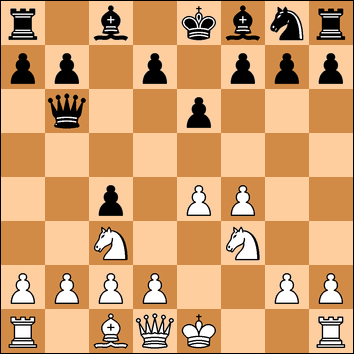
White has an edge because Black is behind in development. I think 10. O-O might be best here but White decides to go after the bishop.

10. Nh4 Bg6

Now if 11. Qg4 Black can't castle because of 11. .. O-O 12. Nxg6 hxg6 13. Qxg6. So 11. .. Qd7 would be a sound defensive move.

11. Nxg6 hxg6


The square of pawns looks odd but I have played it before and it is a great defensive barrier. Not only that but now the h8 rook can develop down the h-file - so it may have been better for White to wait for Black to castle before going after the bishop.

12. g3

To defend the h2 pawn, although 12. h3 might have been more accurate.

12. ...   Nd7
13. Qe2

White prepares to castle queenside and also stops Black from castling because of the loose bishop. I gave some thought to 13. .. Nb6 here with 14. Bb3 a5 but my king safety remained a concern so I came up with a move which I thought was quite novel.

13. ... Kf8!?

As I have the h-file to develop my rook then castling is not necessary. White has the advantage in space and the two bishops, and the computer rates his position as best by two thirds of a pawn. Having said that, I would say that Black's position is not too bad - there are (yet) no obvious weaknesses.

14. O-O-O

Now I wanted to go on the counter attack and came back to the idea of Nb6 or even b5.I looked at 14. .. b5 15. Bb3 a5 16. a4 or 15. Bd3 a5 but instinct told me that this was wrong. Instead I decided to continue to develop and advance in the centre.

14. ..  Nb6
15. Bb3 Rh5

A great square for the rook while I think about what to do with it next.

16. f4

This surprised me. It blocks in the dark squared bishop. I now try to sort out my centre while also aiming to block the diagonal of the other bishop.

16. ...  Nd5
17. Rhe1 Qd7
18. Kb1 Re8
19. Qg2 Nb4


White has 32 minutes for 16 moves. Black has 27 minutes. I was now becoming concerned over White's pressure in the centre and seemed to be running out of things to do. I now expected 20. c3

20. Be3 Bd8

Making use of the opportunity offered by the closure of the e-file to redeploy the bishop.

21. Re2 Bb6
22. Rde1 Nd5

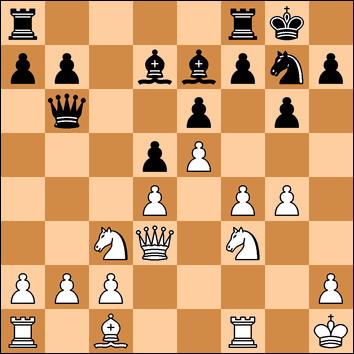
Now White needs to play 23. Bg1 Rxe2 24. Rxe2. Maybe Black can then try 24. .. g5.

23. Qf2?

However this drops a pawn.

23. .. Nxe3
24. Rxe3 Rxe3
25. Qxe3

if 25. Rxe3 then simply Bxd4.

25. ...  Rxh2
26. c3 Bc7

Now back to the g5 plan. With a 4 v 2 (sort of) majority, it was time to advance on that side of the board.

27. Ka1 Rh3
28. Qf3 g5!


I was very pleased to find this move. Now if 29. Qg2 Black should only play 29. ... gxf4 if he is prepared to sacrifice his queen as White has the dazzling 30. Be6!?! Then 30. .. Qxe6 (30. ... fxe6? 31. Qxh3) 31. Rxe6 Rxg3 32. Qh2 fxe6 leaving Black with a rook, knight and three pawns against a queen. The computer says that Black should win this but I cannot say it is an ending I would like to pay.

29. fxg5 Rxg3
30. Qf1 Rxg5

Another pawn picked up.

31. Qc4 Rh5

I was very concerned about a white rook arriving on the h-file so decided to get there first.

32. Qe2 Rh2
33. Qc4 b5?

Poor. An unnecessary weakening of the queenside. Why not just get on with it with f5?

34. Qd3 f5
35. Bc2 f4

At last, Black finds the correct plan and, for the first time, I felt I had serious winning chances.

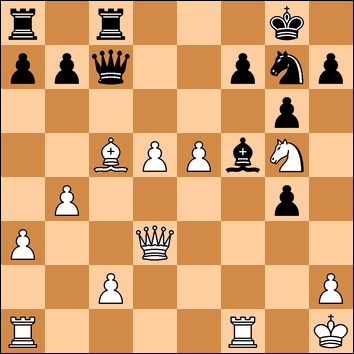
36. Qf3!!

Wow! White sacrifices a bishop to get the h-file. This is an amazingly imaginative move.


The line I saw was 36. ... Rxc2 37. Qh5 Kg8 38. Rh1 and this is looking nasty.

My subsequent analysis reveals:

(a) 38. ... f6 39. Qh7+ picks up the rook on c2.
(b) 38 ... Kf8 then 39. Qh8+ Ke7 40. Re1+ Kf6 41. Qh4+ g5 (if Kf5 then Qh3+ wins the queen - if Kg6 then Rg1+ Kf5; Qh3+) 42. Qh6+ Kf5 - and either 43. Qh7+ or 43. Qh3+ g4 44. Qd3+ also picks up the rook.
(c) Finally there is 38. ... f5 39. Qh7+ and:
(c1) either Kf7 40. Rg1 or
(c2) 39. .. Kf8 40. 40. Qh8+ Kf7 41. Rg1 Kf6 42. Qh4+ Ke6 43. Re1+ Kd5 44. Qh1+ Kd6 and White can now bully the rook with 45. Kb1!! Rf2 (45. .. Rd2 46. Qh4! Kd5 47. Qh1+ Kd6 48. Qh4 and a draw) 46. Qg1 Rd2 (46. .. Rf3 47. Qg6+ Kd5 48. Qg2) 47. Kc1 Rd3 48. Qf1 Rg3/e3 49. Qxf4+.

So the bishop sacrifice is perfectly sound. If White follows through correctly, he has very good chances of a draw or even a win.

I don't know how much of the above my opponent saw, and I certainly didn't see any of it, but, with my clock ticking, my instincts told me that to take the bishop would be a mistake. I am winning anyway so why take risks?

36. ... Rh3!
37. Qf1 g5

Just push pawns and see what happens.

38. Be4 g4
39. a3 f5
40. Bg2 Rh2
41. Qg1

This loses a piece but then 41. Bh1 f3 is not much fun either.

41. ... f3
42. Bxf3 gxf3
43. Qg6

Now I just need to guard against any perpetuals or swindles and it should be a home run.

43. ....... f2


44. Qf6+ Qf7
45. Re8+

An interesting try but the position is lost.

45. ....  Kxe8
46. Qxc6+ Kf8

Everything is guarded and White now resigned. A fascinating and interesting game.

Thursday, 19 May 2016

Game 29 - Swale Club Championship 2015-16 - Final Group - Round Four

Swale Club Championship - Final Group - Round Four
Thursday 19 May 2016
White: K. Nevols (132) - Black: I. Lappin (132)

I calculated that I needed to win my last two games to be sure of third place. In the first round of games, I was fortunate to defeat my opponent in a crazy game and so resolved to play more calmly and positionally this time.

1. e4 g6
2. d4 b6

Not sure what this is called. Perhaps the double fianchetto. I just decide to calmly develop keeping things defended in the centre.

3. Be3 a6
4. Nf3 Bb7
5. Nbd2 Nf6
6. Bd3 h6

I have to confess to being unfamiliar with the system that Black is using. It's a sort of Indian defence, where Black allows White to set up a centre and intends to undermine it. The addition of the moves a6 and h6 might be leaning towards a sort of hedgehog set-up.

7. h3

To prevent any ideas of Ng4 after Bg7.

7. ...  e6
8. O-O c5
9. c3 d6


So I am ahead in development and I have the centre so I must now think of a plan. Placing the queen opposite his undeveloped king seemed an interesting plan. 10. a4 is the computer's suggestion aiming at queenside play.

10. Qe2 Nbd7

Although this keeps the diagonal open for the queen's bishop, I felt it lacked ambition and that Nc6 would have been better for Black. With nothing happening much on d4, and the possibility of a central attack against the un-castled king, I decide to redeploy my Bishop to a better diagonal.

11. Bf4 Nh5
12. Bh2 Bg7?

Was this a pawn sacrifice or a mistake? I gave it careful thought. The lines I could see for Black after Bxd6 involved an attempt to trap the bishop and play in the centre with e5 and Nf4.

Although Bxd6 is the obvious move, a far better move for White would be 13. Nc4! to take the pawn with the knight. Then 13. .. O-O 14. Nxd6 and Black's a-pawn is about to go as well. (If 14. .. Qc7 then 15. g4! Nhf6 16. Nxf7).

However I did not see that option and after assessing if I could eat up the pawn thought ..  well, why not?

13. Bxd6 e5
14. Qe3

This was the move I had foreseen. If 14. dxe5 then I thought Black would win a piece with 14. ...  Nf4 15. Qe3 Nxd3 16. Qxd3 Nxe5 17. Nxe5 Bxe5. But I had overlooked that 18. Nc4 (perhaps followed by moving a rook to d1) would save the day.

14. ....  Nf4
15. Bc2 g5
16. dxe5

The computer thinks taking with the knight is better but I was concerned about the bishop getting cut off and wanted to exchange it and keep the pressure in the centre.

16. ...  Ng6
17. Rad1 Ngxe5
18. Bxe5 Bxe5
19. Nxe5 Nxe5
20. Nc4 Qc7
21. Nxe5 Qxe5
22. f4!


This was the position I had envisaged at move 16. I am a pawn up with my heavy pieces in the centre of the board aiming at his uncastled king. After the game we spent some time looking at this position as to whether Black could hold. We looked at 22. ... Qf6. 23. e5 Qc6 (24. Rd2 seems to hold meeting 24. .. Rg8 with 25. f5) and 22. ... Qg7 (where 23. Rd6 is a good move).

The view of the computer is that Black played the best move - and that his mistake comes later.

22. ...    gxf4
23. Qxf4 Qe6?

The computer thinks this is the mistake. Better would be 23. ... Qxf4 24. Rxf4 Ke7 25. Rdf1 Raf8. After 26. Rf6 White is still much better although the text allows White to finish quicker by winning a pawn and getting the bishop in.

24. Rd6 Qe7
25. Rxb6 Bc8
26. Ba4+ Bd7
27. Bxd7 Qxd7
28. Qe5+

Of course if 27. .. Kxd7 then 28. Rb7+. Now Black will lose a rook and so decided to resign.

Thursday, 12 May 2016

Game 28 - Swale Club Championship 2015-16 - Final Group - Round Three

Swale Club Championship - Final Group - Round Three
Thursday 12 May 2016
White: K. Nevols (132) - Black: T. Owens (170)

Another tough opponent - and the leader of the championship. But I was slightly optimistic after securing a good draw in my last game.

1. e4 e6

The French defence. I had been researching to find a way to play against this popular defence for Black and decided to try the Tarrasch 3. Nd2.

2. d4 d5
3. Nd2 Nf6
4. e5 Nfd7
5. Ngf3

5. Bd3 is usual here with c3 and Ne2, or 5. c3 with f4 and Ndf3 to try to keep the e5 pawn. But I could not see anything wrong with my plan.

5. ....  c5

Now 6. dxc5 is recommended. If 6. .. Bxc5 7. Nb3 Bb6 8. Bf4 or Nbd4 or even a4 - or 7. .. Be7 8. Bf4. If 6. .. Nxc5 then 7.Nb3. Maybe best is 6. ... Nc6 with 7. Nb3 Ncxe5.

Instead my move concedes the initiative at an early stage.

6. c3 Nc6
7. Nb3 cxd4

7. .. c4 8. Nbd2 f6 is interesting.

8. cxd4 f6!

A standard break in the French and a sign that Black is already better.

9. exf6 Qxf6


Now I make a mistake. White needs to get the kings' bishop developed and castled. So Be2, Bd3 or Bb5 are options here. Instead I notice the opportunity to develop while hitting the queen and completely overlook a check.

10. Bg5? Bb4+

And White should now just admit the mistake and play 11. Bd2 where Black could follow up with Qg6 or Bd6.

11. Nbd2 Qg6

White is considerably tied up and has to break the bind. I wanted to get my queen to the d3 square where it could add to the defence. I gave some thought to 12. a3 and also to 12. Qe2 where Black has the interesting 12. .. h6 13. Bh4 Qc2! (14. Qxe6+ Kf8 15. Qxd5 Qxb2 16. Rd1 g5 17. Bg3 Nf6).

Instead I chose a move which was visually pleasing. But 12. a3 was probably better.

12. Qb1 Qh5
13. Qd3 O-O
14. Be2?

After the game my initial thought was that I should have played 14. Be3 to withdraw the bishop out of harm's way. Black can then choose between 14. .. e5 or 14. .. Nf6. However the best move appears to be 14. O-O-O which breaks the pin, stops the Rxf3 trick, and gets the king out of the centre. Even then Black still has active plans with ides such as Bd6 and/or Nf6.

14. ... Rxf3!
15. Bxf3 Qxg5

Two pieces for the rook. The computer states that Black has now won - well, I am not finished yet.

16. Qe3 Qf6

Gobbling up a pawn.

17. O-O Bxd2
18. Qxd2 Nxd4
19. Bd1 Ne5!

Exploiting the fact that I can't take the knight on d4 because of Nf3+.


Now the game is resignable. Black has two formidable knights and a dangerous passed d-pawn. The only thing I can try to do is to hold off the immediate threats and get the rooks into the game.

20. b3

To prevent Nc4.

20. ...   Bd7
21. Be2 a6
22. Rfe1 Rf8
23. f3 Ng6

The knights continue to circle like vultures. Another idea would have been 23.. Bb5. (24. Bxb5 Ndxf3+! or 24. Bd1 Nd3).

24. Rad1 e5
25. Qa5

Hoping to get the chance to infiltrate.

25. ...  Bc6
26. Bd3 Nf4
27. Bf1 Nh3+!

Visually impressive and now finishing off in fine style.


28. gxh3 Nxf3+
29. Kh1 Qf4
30. Re2 d4
31. Rg2 Nh4

All Whites' moves are forced.

32. Qe1 Qxf1+
33. Qxf1 Rxf1+
34. Rxf1 Bg2+
35. Kg1 Bxf1
36. Resigns

A very impressive game from Black. Meanwhile, for me, it is back to the books to find out how to play against the French defence.

Thursday, 28 April 2016

Game 27 - Swale Club Championship 2015-16 - Final Group - Round Two

Swale Club Championship - Final Group - Round Two
Thursday 28 April 2016
White: K. Nevols (132) - Black: K. Hyde (170)

Any real chances I had to catching up the top two were now gone - but with four games left I needed to consolidate third place. This game was a rematch with the club champion and highest graded player. In a sense, I felt more relaxed as I assumed it would be a defeat (!) and so I had nothing to lose.

1. e4 c5

Time for another Closed Sicilian, but this time I decided to delay the development of the king's bishop.

2. Nc3 Nc6
3. f4 g6
4. Nf3 Bg7
5. Be2

I decided to try the bishop on this square, behind the d3 pawn, for a change. Unambitious perhaps but adds to the defence and avoids the possibility of Black gaining tempi on the queenside by attacking it.
Playing 5. g3 with Bg2 is another possibility to be tried one day.

5. ... d6
6. O-O e6
7. d3 Nge7

Black decides to deploy his knight so as to not disrupt the bishop's diagonal and keeps firm control of the d4 square.

8. Qe1 O-O
9. Qh4

This is a standard manoeuvre of the system that I play. Pieces are moved generally in the direction of Black's king. Learning from my last game, however, I was intent on avoiding a pointless sacrifice on the f5 square.

9. ....   Nd4
10. Bd1 d5!

The standard counterplay. I read somewhere that if Black can play d5 in a Sicilian defence then he is doing well. I decide to create a small weakness and redeploy the knight out of range of his d4 counterpart.


11. Ng5 h6
12. Nh3 Nec6

The move that had concerned me was 12. .. b5 grabbing the initiative with ideas such as b4 and maybe later Bb7. Now I decide to try to blunt Black's play with exchanges.

13. Qxd8 Rxd8
14. Ne2

Now Black, clearly ahead, has the possibility of 14. .. b6 with one line being 15. c3 Nxe2+ 16. Bxe2 Ba6 with pressure in the centre.

14. ...   dxe4
15. dxe4 e5!

Breaking in the centre and opening up the diagonal of the queen's bishop. I was now getting concerned with the familiar feeling of slowly being outplayed.

16. c3


16. .... Nf3+

I did not see this until just after I played c3. This move exploits the overwork of the rook on f1. While Black thought about the move, I could not see any immediate danger.

17. gxf3 Bxh3
18. Re1

Now Black has a pleasant choice of plans. He could try 18. .. Bf6 with the idea of coming to h4. He could try Rd3. Or, as here, redeploy the bishop.

18. ...  Be6

Although I am slightly worse, it is not yet in the disaster phase, and I felt slightly better than a few moves ago. Time for the bishops to do some work.

19. Be3 b6

One alternative idea is 19. .. Rd3 20. Bxc5 b6 21. Bf2 Rxf3

20. Ba4 Rac8!?


This is an interesting pawn sacrifice which I now spent some time looking at. 21. Bxc6 Rxc6 22. fxe5 Bxe5 23. Bxh6. I decided against it, as it seemed wrong by instinct to bring both his bishops to the centre and open the h-file for a Black rook to beam down towards the h2 square.

Black told me afterwards that he was thinking of ideas revolving around playing g5 - which I had not considered. One line could be 23. ... Bc4 24. Kg2 g5!? 25. Bxg5 Rg6 with f6 coming up. I think 24. Kh1 puts an end to those ideas - had I seen the g5 possibility.

Instead I just decide to play safe and improve the king's position.

21. Kg2 Kh7

Defending the pawn - the computer thinks 21. .. Rd3 is a useful try exploiting the fact that White still lacks some co-ordination.

22. Bb5

To defend the c4 square.

22. ...  Na5
23. fxe5 Bxe5
24. Nf4 Bc4

But Black plays it anyway. I did not like 25. Bxc4 Nxc4 26. Rb1 with Black strong down the d-file so decide to move the bishop back to a better square. I had to find some counterplay against Black's dominance of the d-file and mobile queenside pawns.

25. Ba4 b5
26. Bc2 b4
27. Ne2 Bxe2
28. Rxe2 bxc3
29. bxc3


The recommended move is now 29. .. Nc4! with the threat of Nxe3 and Rd2+. So 30. Bc1 Rb8 and White is really struggling to move.

29. ...  Bxc3

Now a pawn down - my hope is to get some active play by use of the rooks and bishops. First, I grab an open file.

30. Rb1 Bd4

Again 30. ... Nc4 is better.

31. Bf4!

I was pleased with this. By hitting the b8 square, my rook can't be challenged and I have chances now to exploit down the b-file.

31. ...   Nc6?

The best move is, not easy to see, 31. ... Kg7 then if 32. Rb5 Nc4 remains a good square for the knight. There is the upcoming possibility of g5 which forces the white bishop back to the c1 square (if Bg3 then Nh3+). There is also the prospect of bringing the knight back to the d6 square where it defends the f7 pawn and the b7 invasion square.

On c6 the knight goes off astray. Now I can invade the seventh rank and win the pawn back.

32. Rb7 Kg7
33. Bb3 c4

The computer claims 33. .. g5 34. Bg3 Ne5 is a better defence with 35. Bxe5 Bxe5 36. Rxf7+ Kg6 37. Rxa7 c4 38. Ba4 Ra8. Black is a pawn down but the c-pawn is very well advanced.

34. Bxc4 Ne7


At the time I was impressed at this ingenious defence. But now I completely miss 35. Bc7! - an equally ingenious move. The rook has to move off the d-file (34. ... Rd7 35. Be5+) and then White could follow with Rc2 (defending the white squared bishop) and threaten Bd6 - and Black's seventh rank looks woeful.

35. Bb3 Bc5
36. Be3

And again missing a strong attack. 36. Rc2! (threatening Rxc5) Ba3 37. Bc7! Rf8 38. Rxa7 Ra8 39. Rb7 and White has all sorts of possibilities with attacks Rd2-d7 or Be5 and Rcc7.

Discovering this strong attack after the game against such a strong player was quite upsetting. My mood at the time was optimistic as, having regained the pawn, I thought I had good chances for the draw. I never thought I could win.

36. ....  Bxe3
37. Rxe3 Rd2+

Black now finds counterplay which concerned me greatly.

38. Kh3 Kf8
39. Rxa7 Rc1
40. Kg3 Rg1+
41. Kh3

If 41. Kf4?? then Black takes the game with g5+ 42. Ke5 Nc6.

41. ... Rh1
42. f4 Rdxh2+
43. Kg4 Rh4+
44. Kf3 R1h2

And Black offered a draw (?) which was accepted. This was a relief as I think Black could be better in this position. The best line from here is 45. e5 Nf5 46. Re1 Nd4+ 47. Ke4 Nxb3 48. axb3 Rf2 and the question is whether White can drum up enough play to counter Black's play.

Thursday, 21 April 2016

Game 26 - Swale Club Championship 2015-16 - Final Group - Round One

Swale Club Championship - Final Group - Round One
Thursday 21 April 2016
White: K. Nevols (132) - Black: T. Jeffries (118)

And so into the final group. The top six of the club championship were to play each other again - with colours reversed. I was in third place but 1.5 points behind the top two.

My first game was a return of a tough match I had been involved in earlier.

1. e4 c5

The Sicilian Defence - I decide to enter the closed variation.

2. Nc3 Nc6
3. f4 e6
4. Bb5 Nd4

An unusual move threatening to play against the bishop. The computer now recommends 5. Bf1.

5. Nf3 Nxb5
6. Nxb5 Qb6

Black has made three of his six moves with a knight that is no longer there! Probably best now is 7. c4 to defend the knight and keep a bind in the centre.

7. Nc3 c4


Opening the diagonal of the queen to prevent White castling and disrupting development all round. I gave some thought here to 8. d4 cxd3 9. Qxd3 Nf6 and then see what I could do about developing the queenside. I also thought about 8. d3 just to get rid of that pawn. 8. Ne5 is also interesting with either d4 or Qe2 to follow.

Instead I decided to develop the queen and see if I could round up that pawn.

8. Qe2 Nf6!?

But Black sacrifices it for some play in the centre. This surprised me. Well, as Bobby Fischer (or someone) once said 'a pawn is a pawn is a pawn'.

9. Qxc4 Be7
10. d4

I was feeling quite confident with the position but, as I let go of the pawn, I suddenly saw 10 .. Nxe4. I pondered the position after 11. Nxe4 d5 12. Qd3 dxe4 13. Qxe4 O-O and thought, OK, I'm still a pawn up so it is not too bad once I can settle the position of the king. That queen on b6 was becoming a right pain.

10 . ...  O-O

Instead Black stays calm and castles. I decide now to prevent any Nxe4 tricks.

11. Qd3 d5
12. e5 Ne8

Although White has gained space, and has pushed Black's pieces back, Black now has chances of pawn breaks. My own mind is now looking at attacking the kingside. I considered 13. f5 here but instead decided to get the king safe and bring the rook to f1 before those sort of thoughts.

13. O-O g6

That's an end to f5. Now I have 45 minutes left for 22 moves.

Now here 14. a4! is a good move gaining some space on the queenside and following up with b3 and Ba3, or think about a5. If Black replies with a5 then the b5 square becomes free for a knight. Instead, my eyes were looking at the kingside and a desire to throw pawns forward.

14. Kh1

Moving off the queen's diagonal, improving the king's safety, and thinking of Rg1 if the g-file opens after g4 and f5.

14. ....  Ng7
15. g4 Bd7

Now the lines are set. Although White is still a pawn up. it is difficult to make progress. Black's kingside defences seem quite solid and making space on the queenside might make sense - again with a4. Black could think about a f6 break.


16. f5?

A mistake. I was thinking about a kingside attack, with opening the g-file and moves like Rg1 and Bh6.

16. ...   exf5

 ... and did not see that this was possible. I had ruled it out because of ...

17. Nxd5 Qd8

Now the computer recommends 18. g5!? . the idea being to restrain Black's kingside and then 18. .. Ne6 19. Nxe7 Qxe7 20. d5 with good play. I did not see this.

18. Nxe7 Qxe7
19. Bg5 Qb4
20. a3 Qb6

Of course 20. ... Qxb2 21. Rfb1 traps the queen.

Now I am very concerned about the c6-h1 diagonal. I could see the bishop, which I had previously kept quiet, now coming to c6. Also the pawn is still loose on g4, and Black has ideas of Ne6 and rooks coming to the c-file. It did not look good. Probably it was time to grovel with gxf5 and bringing the bishop back. Instead I decide to try to improve the position of my bishop.

21. Be7 Rfc8
22. Bc5 Qc6

Instead I've put it in harm's way. The queen is nicely placed opposite the king, and b6 is now threatened winning a pawn.

23. b4 fxg4
24. d5 Qc7
25. Ng5

With 12 minute left for 13 moves - an attempt at counterplay.

25. ...  Bf5


26. Qe2??

Better 26. Qd4. Now Black has a forced win of material with 26. ... Qd8 27. Ne4 Qxd5 28. Rae1 b6 29. Bd6 Rc4 30. Rf4 Ne6.

26. ...  b6?

Phew, my first bit of luck.

27. Bd4?

Ruined again - 27. .. Qd8 was now even stronger. 28. Ne4 Qxd5 and two pieces are under attack. 27. Bd6 would have been better.

27. ...  Qxc2

Missed again. But Black's position is now so good that it does not matter. White's only hope is to get the pawns going. It is strange how both sides have completely forgotten about the knight - stranded on g5 and continue to do so.

28. Qe1?

Should have played 28. Rae1

28. ...  Qc4!

28. .. h6 picks up the knight (it can't move because Be4 is deadly) but this is the final winning move. The d-pawn is about to fall and the rooks enter the game.

29. Qe3 Qxd5+
30. Kg1 Rc2
31. Rf2 Rac8!

White can resign now.

32. Re1 Rxf2
33. Qxf2 Rc2
34. Re2 Rxe2
35. Qxe2 Qxd4+

Well mopped up. White's position is hopeless and I resigned.

Thursday, 31 March 2016

Game 25 - Swale Club Championship 2015-16 - Round Ten

Swale Club Championship - Round Ten
Thursday 31 March 2016
White: K. Nevols (132) - Black: B. Sawyer (87)

Having now secured my place in the top group, I needed to get a draw from my final game to finish the first round in third place.

1. e4 g6
2. d4 Bg7

2. .. Nf6 would take us into the Pirc. Now I decide to take us into the Kings Indian defence, an opening I know much better (although usually as Black).

3. c4 d6
4. Nc3 e6

I think I'd prefer 4. e5.

5. Nf3 Ne7

An unusual placement for the knight. The usual thoughts in this opening have to be slightly adjusted by the fact the bishop on g7 is now not blocked by the knight which usually sits on f6. I made a mental note to keep an eye out for tactics revolving around c5, Qb6 and any attacks on the b2 square.

6. Bg5

With the intention to cause a weakness around the kingside. If now 6. .. h6 my plan was to play 7. Be3.

6. ... O-O
7. Qd2

And now h6 cannot be played.

7. ... Kh8?!

A surprise. I had expected c5, Nc6 or Na6. I can only guess the plan is to play the knight to g8 and then h6 but this is too slow. The knight is still pinned at the moment.

8. h4!


I decide to punish the last move and go straight on to the attack. I was in two minds here. Part of me was saying I ought to play it safe and play Be2 and castle, while the other said go for it. I analysed both 8. .. e5 to which I planned 9. d5 closing down the centre, and 8. .. h5 to which I thought about 9. Be2 with possibly Nh2 and g4, or 9. Bh6. I also saw Black's next move and gave some thought to a piece sacrifice.

8. ... f6

The move I gave a lot of thought to was 9. h5?! - inspired by a Kasparov game many years ago. However I decided against it for three reasons - firstly, I am not Kasparov (!), secondly, there is no need to take risks at his early stage when I am (allegedly) the stronger player and, thirdly, I was not sure if it would work. 9. ..  fxg5 10. hxg6 Nxg6 11. Nxg5 h6 was as far as I got. Instead I stuck to the more sensible move.

9. Be3 Qe8

This defends against h5 but leaves the c7 pawn open. However, 10. Nb5 does nothing against 10 .. Na6 and then 11. .. c6 would show the whole idea is a waste of time.

9. .. e5 would have been better to meet 10. d5 with 10. .. Bg4 and 10. h5 gxh5 11. Rxh5 again with 11. ... Bg4. (10. dxe5 dxe5 11. Qxd8 Rxd8 and White keeps an edge in development but no danger yet).

10. Be2 Nbc6?

But this gives me the chance to now deflect the queen and get h5 in.

Computers usually like pawn pinching and this one is no exception - recommending 11. d5 Ne5 12. Nb5 Qd8 13. Nxa7. I didn't see this but I am not sure I would have gone for it - it would give Black time to play for plans involving a counterattack in the centre around f5.

11. Nb5 Qd7

Now the above sequence is improved by the blocking of the bishop. 12. d5 Ne5 13. Nxe5 fxe5 14. Nxa7 and Nxc8 to come.

12. h5 g5?

Black sacrifices a piece!! I had looked at 12. .. gxh5 13. Rxh5 planning to castle queenside and double up on the h-file.

13. h6 Ng6
14. hxg7+ Qxg7
15. O-O-O

So now I am a piece for a pawn up. The next job is to double the rooks on the h-file.

15. ... a6
16. Nc3 Kg8

Preparing to defend the h-pawn. The other option I had looked at was 16. ... Rg8 17. Rh2 Nf8.

Now I could not decide between Rh2 and Rh5. The former looked wimpy - one gets a sense of manliness when one shoves the pieces into the opponent's face! - but after Black had played Kf7 and Rh8 I knew there might be a chance of Bd7-e8 which would get a tempo. Also, on h2, the g2 pawn is defended - which might be useful.

17. Rh2 Kf7
18. Rdh1 Rh8

OK, where next? My eye went to the g5 pawn. If I could undermine it and somehow get the knight or bishop there I would further increase my advantage.


19. e5!

The variation I looked at first ran basically like this. 19. ...  dxe5 20. dxe5 Ncxe5 21. Bxg5? fxg5 22. Rxh7 Rxh7 23. Rxh7 Qxh7 24. Nxg5+ Kg7 25. Nxh7 Kxh7. That would leave my with a queen and a pawn for a rook and a knight. But I decided against that as it was giving up too much material just to get the queen. Remember - I am already a piece for a pawn up.

And then I saw the beautiful - 21. Nxe5+ Nxe5 22. Bh5+ Ke7?? 23. Bc5 checkmate! So Black would have to play 22. .. Ng6. I pondered about 23. Ne4 and also 23. Bxg6+ Kxg6 24. Qd3+ (24. .. f5 25. Bd4 e5 doesn't go very far) but then decided this was all too far into the future, I must have got something wrong somewhere, and my head was hurting.

So I decided to play e5 anyway on instinct - the worst that could happen was losing a second pawn for the piece I was up.

19. ...  h6

Instead Black decides to protect the g-pawn resulting in the following sequence.

20. exf6 Kxf6
21. Ne4+ Ke7
22. Rxh6

So that 22. .. Rxh6 23. Rxh6 Qxh6 24. Bg5+ or 23. Bg5+.

22. ....  Bd7
23. Bxg5+ Kf7
24. Bf6!


I was pleased to find this move which opens the diagonal for the queen to join in. The end is nigh!

24. ... Rxh6
25. Rxh6 Qg8
26. Nfg5+ Ke8

If 26. ... Kf8 then 27. Nh7+ with Bh5 next.

27. Bh5 Nce7
28. Rh8 Resigns

A nice touch to finish off - pinning two Black pieces.

Monday, 21 March 2016

Game 24 - club match. Weald of Kent vs Swale

Weald of Kent vs Swale - Board One
Monday 21 March 2016
White: H. Cove (159) - Black: K. Nevols (132)

Back to Cranbrook Library - it really is a pleasant place to play chess but quite a drive to get there. However I was not too pleased to see I was Black against a player graded far higher than me (my record this season against players graded over 150 - two draws and five losses) and, as he sat at the board, a young chap full of confidence, I knew this would be a tough night.

1. d4 d5

After my recent disaster with the King's Indian, I decide to give up the Indian openings for a while and fight it out in the centre.

2. c4 e6
3. Nf3 Be7

The idea of playing this move before Nf6 is to avoid the pin after 3. .. Nf6 4. cxd5 exd5 5. Bg5. It usually transposes anyway, or White could play 4. cxd5 exd5 5. Bf4 with e3.

4. g3

But this takes us into the Catalan opening - another opening I know nothing about, other than Kramnik used to be fond of it. Now Black could take on c4 and spend the rest of the game trying to defend it, but I did not like the idea of the open diagonal, nor playing an unfamiliar system so instead I go into my shell.

4. .. Nf6
5. Bg2 O-O
6. O-O c6

White delays developing his queen's knight which I found unusual. Now the main problem I have is what to do with my queen's bishop.

7. Qc2 Nbd7
8. Nbd2 Re8

I could see he was now playing for an e4 break so I prepared myself to meet it.

9. e4 dxe4
10. Nxe4 Nxe4
11. Qxe4 Nf6
12. Qc2


Neither side has achieved a great deal but White has the edge on better development. Black's set up is similar to what I have often got with the Scandinavian defence but not with the bishop on c8 so a bit of shuffling is called for.

12. ... h6
13. Rd1 Qc7
14. Bf4 Bd6

Here I was worried about 15. Ne5 but 15. .. c5 seems to be an adequate reply

15. Bxd6 Qxd6

Now 16. c5 Qc7 17. Ne5 with Nc4 and Nd6 concerned me. I would have had to play Ne8 at some point and maybe I could hold.

16. Ne5 c5

So I thought I had to get this move in quick. Of course this opens up the bishop for the diagonal but I could not see much else - and the computer seems to agree with me.

17. Qc3 Rb8?

A blunder. 17. .. Qc7 would have been better. Now 18. Qa3 simply wins a pawn. Maybe then I would have played 18. .. a6 19. Qxc5 Qxc5 20. dxc5 so his extra pawn is doubled, but the position is horrible. Compare White's pieces to Black's!

18. dxc5?

Phew, he doesn't see it.

18. ...  Qxc5
19. Rd2!

Strong. White builds up his strength, preparing to double on the d-file. I decide the first thing to do is to get rid of that knight on e5.

19. ...  Nh7
20. Rad1 f6


Now White has the crushing 21. Rd8! and after Rf8 (21. .. Rxd8 22. Rxd8+ Nf8 23. Ng6) 22. Ng6! Rxd8 23. Rxd8+ Kf7 24. Nh8+ Ke7 25. Rg8! Nf8 26. Rxg7+ Ke8 27. Qxf6 it is well and truly goodnight.

Fortunately (again) he does not see this. And, to be fair when your pieces are attacked, you do tend to focus on defending them.

21. Nd7?

But I was glad to see this as I can exchange my duff bishop for his active knight.

21. ..  Bxd7
22. Rxd7 Re7
23. b4 Rxd7

A useful intermezzo - offering the queen for two rooks - but it is the only move.

24. Rxd7 Qc8

The computer favours the more active 24. .. Qf5 with Ng5 to follow, but I am in grovelling mode and wanted to keep the queen on the base line. He has 3v2 on the queenside, and very active pieces, so although I had escaped twice, it was still looking gloomy.

25. Qd3 Nf8

The knight does a great defending job on this square - holding on to the e6 pawn and guarding the d7 square as well as shielding the back rank.

26. Rd6 Qc7

Preparing my next move.

27. c5 a5
28. a3 axb4
29. axb4 Ra8

Now I have exchanged off one pair of pawns and now the a-file to at least wave in the direction of a counter attack. Swapping another pair of pawns with 29. .. b6 might have been an improvement.


30. Qd4 Qe7
31. h4 Rb8

I'm not doing anything really, just moving pieces about and giving White the question of how he will advance - which he does. The computer now suggests 32. Rb6 and then moving the queen to f3 to try to pick up the b7 pawn.

32. b5 Qc7
33. b6 Qe7

Now good for White would be to relocate the bishop via e4 or f1.

34. c6 bxc6


Now I was expecting 35. Rxc6 and thinking what should I do next. 35. .. e5 perhaps? 35. .. Rd8 maybe. Or 35. .. Qd7. But my thoughts were interrupted by ...

35. Bxc6?

Wow! For nearly three hours I had sat in my chair, defending like crazy, moving pieces around on the back line, escaped defeat on probably a dozen occasions - but I was going to get away with it. White has blundered a pawn to a one move tactic.

35. ...  Rxb6

Now White has nothing. I did feel some sympathy for White (we've all been there - a win thrown away with a careless move) - but huge relief as well.

36. Qxb6 Qxd6
37. Qb7 Qd1+

With this move I offered a draw. Yes, I have an extra pawn but his bishop is a better piece than my knight, and it is 4v3 on one side. He is also graded far higher than me and a draw with Black would be a feather in the cap. I guessed his feelings of disappointment would make him accept straight away - but that was not quite right.

38. Kg2

He declines.

38. ..    Qd8

So back I go. And how exactly, a pawn down, do you plan to win this?

39. Be4 Qd7
40. Qb3 Qd6
41. Qb7 Qd7

And now he re-offered the draw and I accepted.

As predicted, a tough battle, but this evening, lady luck was with me.